


The following exchange took place between November 2025 & January 2026.
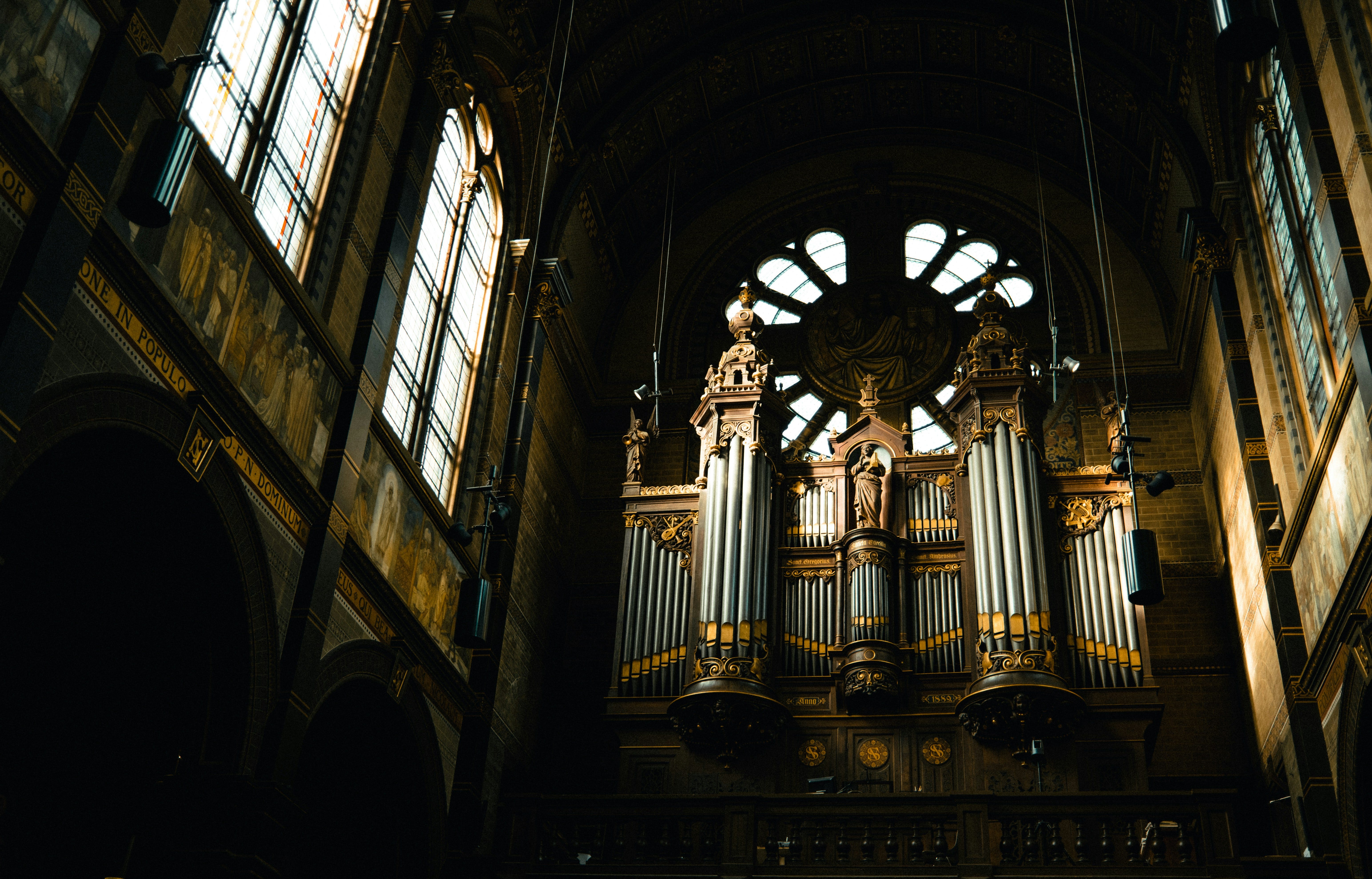
NB: The relationship between music and experience enchants and confounds me. I know that sound — not to mention silence — profoundly impacts the way I process encounters, but words fail me when trying to describe the nature of the experience.
AG: Music is often the topic of discussion and debate in the church and public square, but it is scarcely understood or appreciated in its power to engage every one of our faculties. This is not to undervalue the power of any other art form; literature, visual art, architecture, dance, and the like all have their own unique way of drawing us out of ourselves and into an encounter with the spiritual realities (whether we’re aware that art is designed to connect us to God or not). For me personally, though, music has always been the very thing that helps me be receptive to grace.
NB: Regardless of religious bent, we’ve all had those magical experiences: at a concert, during Christmas Eve Vigil, in the car blaring that one song that really breaks you open, or even while the score backgrounding your favorite movie scene plays . . . when the veil between heaven and earth thins, when music perfectly complements the moment in time. Fiction and film are my preferred media for creative expression, and I certainly understand them better as art forms, but music is unique somehow. It communicates truth to me without images, on a level beyond words. Just as visual art draws my gaze upward, music redirects my gaze inward.
AG: It does seem that music is unique in how it is experienced in those more tender moments. Most art forms (literature, architecture, visual art, music) have an ordinary place in our daily lives, but also an extraordinary purpose when employed in the sacred liturgy. Take literature, for example: I recently read The Fellowship of the Ring with my 11-year-old daughter and watched as Tolkien’s fearful description of the mines of Moria transformed my daughter’s experience of our nighttime reading routine (she was on the edge of the bed yelling as Gandalf and the balrog fell into the dark abyss). Literature is indeed powerful, and can shape our attentions profoundly.
NB: Not to mention our imaginations. That Moria scene certainly still looms large in mine.
AG: Right? We can sense this at a height in the Mass as we listen attentively to the Gospels. Hearing the Passion of Christ on Good Friday is an example par excellence of the liturgy’s use of spoken word to command our full attention. Still, there are also art forms that don’t have a natural home in the liturgy. Take, for instance, dance or film; there is not quite a sense that these art forms flow from the Mass and into the tributaries of daily life. Dance and film can still be very beautiful, or convey goodness and truth, but those qualities don’t derive first from a liturgical expression (and perhaps more from a “groundedness” in the lives of the artists themselves). Music, in this sense, stands alone as an art form. At its height in the liturgy, music reveals something of God as we are drawn together in worship of Him. Yet also, music flows into our daily lives, where God seems to encounter us through song in the everyday. It’s why we can fairly say that chant and polyphony elevate our hearts and minds to God in the Mass, but that doesn’t diminish the value of a praise and worship song (or maybe even a classical piece or a folk song) that breaks us open in other ways. Both are experiences of something sacred expressed in music, one with a proper home in the liturgy and the other rightly belonging to our daily lives.
NB: I’ve thought a lot about music from an experiential perspective, both from the point of view of the artist and audience, but I hadn’t considered that liturgical connection. Considering the impact of a location on a concert — with all the atmospheric and acoustical concerns that choice brings — it makes perfect sense that the principle would apply even more when extended to a sacred setting (speaking both in terms of place and purpose). And I think the way secular and sacred music can mirror each other really has potential to bridge the two worlds.
AG: The church identifies music as “a treasure of inestimable value, greater even than that of any other art” in Sacrosanctum Concilium (1963). The church cites music’s ability to clothe text in beauty as an integral part of the liturgy, but I think there’s more to unveil here about the nature of music itself. Think about a great hymn: it doesn’t just exist on paper; it requires something of us. First it requires a collective, gathering breath — a bookending of sound in active silence — and then our full bodies engage in singing: breath, vibration, and movement. Yes, this is an action of each individual mind, heart, and soul, yet to acknowledge that alone would cheapen the gift that music is. It is first an initiative of God’s; one that unifies us — heart, mind, body, soul — as a gathered body of Christ. There is a “bothness” to music that other art forms don’t quite contain.
NB: I’m glad you brought the word “unveil” into the conversation: that’s a helpful way to describe how music (and art, more broadly) not only shapes our experiences but reveals truth. I think that’s something a secular audience can embrace, as well. Music has the ability to unveil while also leaving aspects obscured — its mystery makes it all the more transcendent. Perhaps that’s also why it is so well suited to enhancing sacred encounters: it can embody both the holy and the mysterious at once. This revelatory paradox reinforces my awe and appreciation for music’s power. It’s as if music allows me to feel the goodness of truth. And by harnessing and channeling the other transcendentals, it offers momentary glimpses of the eternal. I know that sounds effusive, but I mean it sincerely.
AG: You’re not alone in that feeling. It’s not just a spiritual intuition, either: there’s something measurable and scientific behind it. Recently, Switzerland’s University of Bern studied the effects of music on a classical music audience, and found that an audience’s breathing rates, heart rates, and levels of excitement began to synchronize with each other while listening. Nothing else on earth, aside from Christ himself, could break boundaries of language, culture, context, and ideology and still find a group of people unified in such a way.
NB: I’ve certainly experienced the music-inspired unity you’re describing, in both secular and sacred settings. The phenomenon can be contagious, almost hypnotic, which is also why context and intent matter so much. But when properly ordered toward the good and the true, I can’t think of a more awesome or impressive aesthetic experience.
AG: The secular world, especially through high arts like classical music, understands that music is unique in its ability to promote unity. It seems to me that the Church has more to understand, and frankly reclaim, in its ability to leverage music in such a way that it draws us all outside of ourselves and unifies us at the foot of the Holy Sacrifice. Perhaps you should elaborate on how sacred spaces and contexts differentiate an experience of music in a concert hall from an encounter with the divine. Would you say music is, inherently, a sacred experience, or is it the context that matters?
NB: I wouldn’t say that music is inherently sacred, at least not in the deepest religious sense of the word. The phenomenon of sacred music seems to me a meeting of artistic telos and individual devotion, a temporal harmony of objective ends and intimate encounters. So too with sacred spaces. Neither are sacred in an abstract sense: their sacredness is as personal as it is transcendent. Music’s capacity to activate place-based encounters is unparalleled. And yet, full “activation” asks for more than the audience’s tacit acknowledgment of the musician’s original intent — it demands something active within the person receiving the music, as well. Musical activation of a sacred space thus rests on the animation of the individuals who fill it. This applies acutely to sacred spaces, but also more broadly to place-based encounters. Maybe you can help me understand what’s happening here.
AG: Prior to my work in Catholic music (forming musicians for parishes and missionary work at The Vigil Project), I spent a good deal of time in the classical music space: opera, symphony, and extensively in chamber music. It was obvious to me that music was a pathway to an encounter with God, and that the classical concert hall was perhaps one of the least evangelized places. I became curious: how could it be . . .
This dialogue is incomplete because it is still happening; Part 2 will be published on Andrew Goldstein’s Substack as soon as possible. In the meantime, I encourage you to explore his archive of helpful essays to learn more about this subject.
